
Educational Article
⚠️ Important Disclaimer
Mutual fund investments are subject to market risks, including the possible loss of principal. This article is purely educational and does not constitute investment advice, recommendation, or solicitation. Do not make any investment decisions based solely on this content. Past performance is not indicative of future results. Returns may be higher, lower, or negative. This content is part of distribution‑related education and does not constitute SEBI‑registered investment advice. For personalised guidance, consult an AMFI‑registered mutual fund distributor.
📊 SIP Wealth Projector
🔒 LockedAbout the Author
Amit Verma
AMFI‑Registered Mutual Fund Distributor (ARN‑349400)
Verifiable at amfiindia.com
📌 Quick Summary
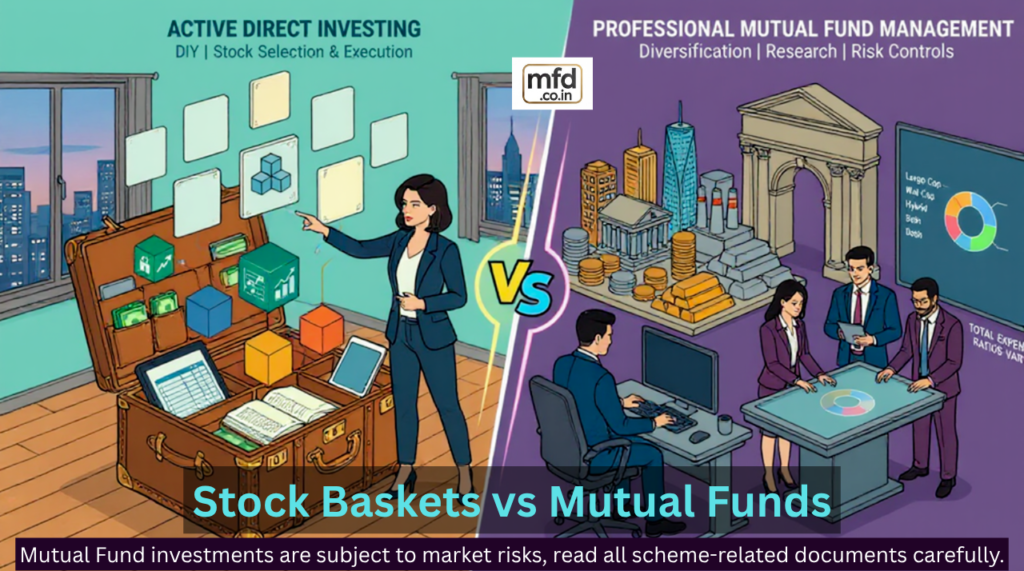
Here is a high‑level overview of the core differences for mobile readers.
| Aspect | Stock Baskets (Themed Stock Baskets) | Mutual Funds |
|---|---|---|
| What you own | Individual stocks in your demat account | Units in a professionally managed trust |
| Diversification | Moderate (10–30 stocks) | High (40–100+ securities) |
| Regulation | Stocks regulated; basket construction generally has lighter regulatory oversight compared to mutual funds | Strictly regulated under SEBI Mutual Fund Regulations |
| Minimum investment | Usually higher (₹5,000–₹25,000+) | Low (₹500 SIP possible) |
| Costs | Brokerage + taxes + platform/subscription (if applicable) | Expense ratio (regulated and predictable) |
| Taxation | Each rebalance can trigger capital gains | No tax impact on internal rebalancing |
| Best suited for | Experienced investors with higher risk tolerance | Beginners and most retail investors |
Both options are subject to market risk; no investment structure can eliminate the possibility of losses.
These are broad educational distinctions. Actual suitability always depends on your risk profile, time horizon, and personal circumstances.
Why This Question Matters in 2026
More investors today are exploring themed stock baskets alongside mutual funds. A common question naturally follows:
“Are these similar to mutual funds? And which one may be suitable for me?”
At a basic level, both provide exposure to equity markets. However, they differ significantly in structure, cost, taxation, and the level of effort required from the investor.
What Are Mutual Funds?
A mutual fund is a professionally managed investment vehicle where money from multiple investors is pooled and invested according to a defined objective.
When you invest, you receive units, and the portfolio is managed within a structured regulatory framework.
Key Characteristics of Mutual Funds
- Broad diversification across sectors and companies
- Professional management with research support
- Daily liquidity in most schemes
- Transparent disclosure (NAV and portfolio updates)
- Mutual funds are subject to market risk; returns can be positive, lower than expected, or negative
What Are Themed Stock Baskets?
Themed stock baskets are pre‑defined portfolios of individual stocks, typically built around a theme, sector, or strategy.
When you invest:
- You directly own the stocks in your demat account
- You execute transactions and rebalancing
- You track performance at an individual stock level
These are general educational descriptions; actual products and features may vary across platforms.
Key Characteristics of Themed Stock Baskets
- Direct ownership of stocks
- Moderate diversification
- Theme‑based investing
- Investor‑led execution and tracking
Mutual Funds vs Stock Baskets: Core Differences
| Aspect | Mutual Funds | Stock Baskets |
|---|---|---|
| Structure | Pooled investment vehicle | Collection of individual stocks |
| Ownership | Units of fund | Direct shares |
| Diversification | High | Moderate |
| Management | Professional fund manager | Strategy provider; execution by investor |
| Regulation | Comprehensive SEBI regulatory framework | Basket construction generally has lighter regulatory oversight compared to mutual funds |
| Cost structure | Expense ratio | Transaction‑based + possible platform fees |
| Tax impact | Efficient (internal rebalancing not taxed) | Each rebalance may trigger taxes |
| Effort required | Low | Higher |
Effort includes tracking individual stocks, executing rebalancing transactions, and managing tax and corporate‑action‑related details.
Effort, Discipline, and Behavioural Differences
Over time, the difference between these approaches is not just structural — it is behavioural.
With Mutual Funds:
- Focus remains on long‑term goals
- Investment process is relatively structured
- Lower need for frequent decision‑making
With Stock Baskets:
- Requires ongoing monitoring of multiple stocks
- Rebalancing decisions must be executed by the investor
- Individual stock movements may trigger emotional reactions
Investors who reduce emotional decision‑making and follow a clear, disciplined approach are generally better positioned for long‑term outcomes.
Cost Reality: What You Should Understand
Over time, differences in structure and costs can meaningfully impact both returns and effort.
In mutual funds:
- Most costs are captured within a single, regulated expense ratio, making them relatively predictable.
In stock baskets:
- Costs arise at each transaction level, including:
- Brokerage charges
- Securities Transaction Tax (STT)
- Stamp duty and applicable levies
- Platform or subscription fees (if applicable)
These costs can accumulate, especially if rebalancing is frequent.
Taxation: A Practical Difference
Tax rates and rules are subject to change as per prevailing law. Investors should verify current rules and consult a qualified tax professional.
As per current rules (FY 2025–26 / 2026–27):
- Short‑Term Capital Gains (STCG): 20%
- Long‑Term Capital Gains (LTCG): 12.5% above ₹1.25 lakh
Comparison Table
| Scenario | Mutual Funds | Stock Baskets |
|---|---|---|
| Internal rebalancing | No tax impact for investor | Not applicable |
| Investor‑level transactions | Tax applies on redemption | Tax applies on every sale |
Key Note:
In mutual funds, only the investor’s redemption triggers taxation.
In stock baskets, each rebalance or sale may create a taxable event.
Which May Be More Suitable for You?
✔️ Mutual Funds May Be More Suitable If You:
- Are relatively new to investing
- Prefer simplicity and structure
- Want professional management
- Are investing for long‑term goals
- Prefer disciplined investing through SIPs
This assumes the selected schemes are aligned with your time horizon and risk profile.
These are general observations only. Individual suitability depends on your personal financial situation, goals, and risk profile.
✔️ Stock Baskets May Be Considered If You:
- Understand equity markets well
- Are comfortable with higher volatility
- Can track and manage multiple stocks
- Have the time and discipline for execution
This assumes you understand that concentrated portfolios can be significantly more volatile than diversified mutual fund investments.
These are general observations only. Individual suitability depends on your personal financial situation, goals, and risk profile.
A Practical Approach: Core and Satellite Strategy
Some investors use a core and satellite approach:
| Portfolio Layer | Allocation | Purpose |
|---|---|---|
| Core Portfolio | 70–80% | Long‑term stability and diversification |
| Satellite Allocation | 20–30% | Tactical or thematic exposure |
These allocation ranges are purely illustrative. Actual allocation should be determined based on your individual risk profile, goals, and after consulting a qualified professional.
Frequently Asked Questions
These are illustrative responses for general understanding and do not constitute personalised advice.
Are themed stock baskets risky?
They can carry higher concentration and behavioural risk compared to diversified portfolios.
Can I invest in both?
Yes, subject to overall portfolio balance and risk alignment.
Which is easier to manage?
Mutual funds are generally simpler to track and manage.
Final Thought
Both mutual funds and stock baskets provide exposure to equity markets, but they differ in structure, cost, effort, and behaviour.
For many investors focused on goal‑based, long‑term wealth creation, mutual funds are often viewed as a structured and disciplined approach.
Stock baskets may be explored selectively, provided the risks, costs, and effort involved are clearly understood.
This article is written from the perspective of an AMFI‑registered Mutual Fund Distributor focusing on goal‑based, Regular Plan portfolios and long‑term wealth creation.
About the Author
Amit Verma
AMFI‑Registered Mutual Fund Distributor (ARN‑349400)
Verifiable at amfiindia.com
I help investors understand different equity‑investing structures and build structured, goal‑aligned mutual fund portfolios through disciplined, long‑term planning.
Not Sure Which Approach Fits Your Situation?
If you’re unsure whether mutual funds, stock baskets, or a combination is appropriate for you, we can explore your options in a structured, goal‑based manner and help you understand how mutual funds fit into your overall plan.
- 📱 WhatsApp: +91‑76510‑32666
- 🌐 Visit: https://mfd.co.in/signup
- ✉️ Email: planwithmfd@gmail.com
Before investing, please read all scheme‑related documents carefully, including the Scheme Information Document (SID) and Key Information Memorandum (KIM).
Final Disclaimer
Mutual fund investments are subject to market risks, including risk of capital loss. This article is purely educational and does not constitute investment advice or solicitation. Past performance is not indicative of future results. Returns may be higher, lower, or negative.
Always read all scheme‑related documents carefully before investing.