
Educational Article
Important Disclaimer
Mutual fund investments are subject to market risks, including the possible loss of principal. This article is purely educational and does not constitute investment advice, recommendation, or solicitation. Past performance is not indicative of future results. Actual returns may be higher, lower, or negative. Do not make any investment decisions based solely on this content. This content is part of distribution-related education and does not constitute SEBI-registered investment advice. For personalised guidance on building an independent, goal-based portfolio, consult an AMFI-registered Mutual Fund Distributor or SEBI-registered Investment Advisor.
📊 SIP Wealth Projector
🔒 LockedAbout the Author
Amit Verma
AMFI Registered Mutual Fund Distributor (ARN-349400)
Verifiable at amfiindia.com
Amit Verma helps investors build disciplined, goal-aligned mutual fund portfolios through Regular Plans with clear and practical guidance. No chasing trends. No panic-driven moves. Just a clear path to life goals. This guidance is provided via Regular Plans offered through AMFI-registered distributors; no comparison with other plan types is made in this article.
Quick Summary
Herd mentality – investing because everyone else seems to be doing it, is one of the most documented and consistently costly behavioural patterns in Indian mutual fund investing.
The pattern often follows a predictable cycle:
- Strong performance attracts attention.
- Attention attracts money.
- Late entrants arrive after the easy returns have already been made.
- Performance moderates.
- Disappointment follows.
In 2024, sector and thematic funds attracted ₹1,55,743 crore in inflows. By 2025, as performance cooled, those same categories attracted only ₹37,199 crore, a dramatic reversal driven by return-chasing followed by return-disappointment.
The small-cap story is equally illustrative. In November 2025, small-cap funds recorded inflows up 26.8% compared to the previous month, even as the category was down nearly 5% for the year, a clear illustration of money flowing in after the performance peak.
The solution is not to be contrarian for its own sake, it is to anchor every investment decision in personal goals, timeline, and risk tolerance rather than in what others are currently doing.
This is educational guidance only; individual suitability always depends on personal financial situation and goals.
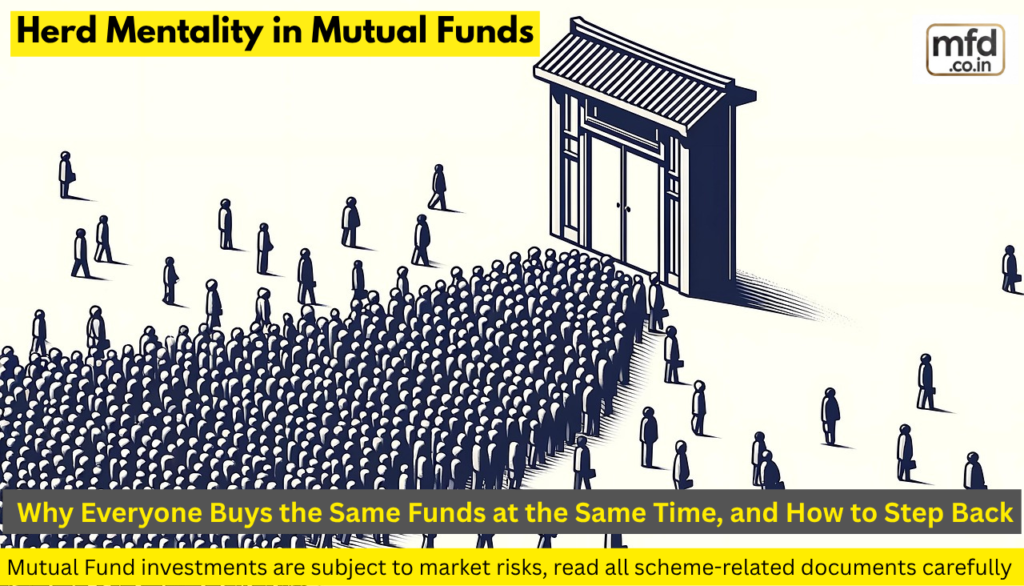
There is a pattern that repeats
A particular fund category delivers exceptional returns, 40%, 50%, sometimes more, over one or two years. Slowly, word spreads. A friend mentions it at a family gathering. A WhatsApp group lights up with screenshots of returns. A financial influencer posts about it. A news article declares the category as “the theme of the decade.”
And then money starts flowing in, not gradually but rapidly. Billions of rupees in a few months. AUM swells. Everyone feels like they are finally investing in something that is working.
At some point, the category’s performance normalises or reverses. The people who entered early did well. Many who entered during the peak of excitement, attracted by those same screenshotted returns, ended up with flat or negative outcomes despite having invested in an apparently popular, well-discussed category.
This is herd mentality in action. It is not a failure of intelligence. It is a deeply human response to financial information, and it affects experienced investors almost as much as beginners. Understanding it clearly is one of the most valuable things an investor can do for long-term investment outcomes.
This article is educational guidance only. Individual investment decisions depend on personal risk profile, goals, and circumstances.
What Herd Mentality Actually Looks Like in Indian Mutual Funds
Herd mentality in investing is the tendency to base financial decisions primarily on what others are doing, rather than on whether those decisions are actually suitable for personal goals and timeline.
It shows up in recognisable ways:
- Investing in a fund primarily because it has recently topped the performance charts, and because people one respects are talking about it.
- Moving money between categories as each one takes its turn in the spotlight.
- Checking the portfolio daily, comparing it with what others around are doing.
- Feeling anxious when a fund category is performing well and one is not in it, and letting that anxiety drive the decision to join.
None of these behaviours are irrational in isolation. They are understandable reactions to the information environment. The problem is not the feeling, it is acting on the feeling without anchoring it to actual goals.
Common patterns that indicate herd behaviour
| Pattern | What It Looks Like in Practice |
|---|---|
| Chasing last year’s top performers | Investing in a fund category after it has delivered 40–50% returns |
| Sector rotation following | Moving money into whichever sector is currently receiving the most news coverage |
| Social proof investing | Buying what friends, relatives, or WhatsApp groups are buying without assessing suitability |
| FOMO-driven decisions | Increasing allocation to equity during market peaks because others are making money |
| Social media influence | Acting on tips from online influencers or financial channels without independent verification |
| Theme-chasing | Investing in a thematic or sectoral fund after the theme has already run up significantly |
The 2024–2025 Story – Herd Mentality in Real Time
The data from the past two years provides one of the clearest illustrations of herd mentality in Indian mutual fund history.
In 2024, sector and thematic funds attracted ₹1,55,743 crore in net inflows, a staggering amount driven by several narratives that were genuinely compelling: defence spending, infrastructure buildout, manufacturing revival, and digital consumption. These themes made sense as investment ideas. But by the time retail investors were pouring money in at record levels, the funds had already delivered the bulk of their performance. Valuations had stretched.
In 2025, as performance across many thematic and sectoral categories cooled or turned negative, the same inflows reversed sharply. Thematic and sectoral funds attracted only ₹37,199 crore in inflows through 2025, a decline of more than 75% from the previous year. The headline narrative had not necessarily changed, but the investor experience for those who entered during the peak of 2024 excitement was often disappointing.
The small-cap story is equally illustrative. In November 2025, small-cap funds recorded inflows that were up 26.8% compared to the previous month, rising flows into a category that was, at the same time, delivering a negative 5% average return for the year. Money was still flowing in even as performance had turned negative, because many investors were still acting on the memory of small-cap performance from earlier periods.
This is precisely the herd pattern at work: inflows peak after performance peaks, not before. By the time the crowd arrives, the early returns have already been made.
These figures are sourced from AMFI industry data for reference. Past flows are not indicative of future flows or returns. Actual individual outcomes may vary.
Why the Crowd Always Arrives Late – The Core Mechanics
Understanding why this pattern repeats itself requires understanding how information flows and how human psychology interacts with financial data.
Past performance is visible and compelling. When a fund has delivered 50% in 12 months, that number appears clearly on every app, every screener, every factsheet. It is concrete. It is recent. It feels real.
Future performance is inherently uncertain. No one can tell with confidence what a fund will deliver over the next 12 months. There is no visible number to anchor on.
Money naturally flows toward what has already worked. When something has delivered strong returns, it feels safer to invest in it than to invest in something that has not yet done so. This is called recency bias, giving disproportionate weight to recent events when forming expectations.
By the time performance is visible to most people, the cycle is often advanced. A fund category that is generating extraordinary returns is typically doing so because valuations were low when the money entered early. By the time that performance is widely visible and being discussed enthusiastically, valuations have often already risen significantly, which mechanically reduces the forward return potential.
The result is that many people who invested at a higher NAV, attracted by strong past performance, end up with lower returns than those who invested when the fund was not yet being widely discussed.
This is not a market conspiracy. It is a natural consequence of performance becoming visible only after it has happened.
The Real Costs of Following the Herd
The consequences of herd-driven investing are not just psychological, they are financially significant and well-documented.
Entering at Elevated Valuations
The most direct cost is mathematical. When an investor enters a category after its strong performance has already played out, that investor is typically buying at higher valuations than the early investors did. This compresses forward return potential.
The Behaviour Gap Compounds Over Time
Research consistently shows a gap between what mutual funds return and what the investors in those funds actually realise. This gap exists primarily because of timing decisions, investors entering after strong performance and exiting after poor performance, repeatedly, across many funds and years. This is the financial cost of herd behaviour, measured across an entire investor population.
Goal Misalignment Creates Structural Risk
Herd-driven investing is almost by definition not goal-driven. When someone invests because a category is popular, that person is rarely asking:
- When is this money needed?
- What would happen if this category fell 30% in the next year?
- Can there be an ability to wait for recovery?
Money that is needed in three years, invested in a high-risk category because it was popular, is structurally mismatched. The popularity of the category is irrelevant to the risk that mismatch creates.
Emotional Exhaustion Over Time
Following the herd requires constant vigilance, monitoring performance, tracking which category is currently performing well, and deciding when to rotate. This sustained effort typically produces worse decisions, not better ones, because more decisions mean more opportunities for emotional bias to influence outcomes.
Tax and Exit Load Drag
Every switch between funds, moving from one popular category to the next as the crowd shifts, potentially incurs exit loads and capital gains tax. Short-term gains from units held for less than 12 months are taxed at 20%, compared with 12.5% for long-term gains. Frequent switches driven by herd behaviour can systematically erode net returns through this tax drag, even before accounting for buy-high, sell-low behaviour.
Exit load and tax rules are subject to change. Current scheme documents and a qualified tax professional should always be checked before making redemption or switching decisions.
The Psychology Behind Why People Follow the Crowd
Understanding the psychological drivers of herd mentality is not just intellectually interesting, it is practically useful, because recognising a bias is the first step toward managing it.
- Social proof – the tendency to assume that if many people are doing something, it must be correct.
- Recency bias – giving disproportionate weight to recent events when forming expectations about the future.
- Fear of missing out (FOMO) – the anxiety of watching others apparently profit while standing aside.
- Confirmation bias – seeking out information that validates a decision already inclined toward.
- Illusion of safety in numbers – believing something is safer simply because many others are doing it.
These biases feel natural, but they are not reliable guides to suitability.
How to Step Back From the Herd – A Practical Framework
The antidote to herd mentality is not contrarianism – deliberately avoiding everything that is popular regardless of merit. It is building a decision-making process that is anchored in personal circumstances rather than in collective behaviour.
This is a general educational framework only. Individual suitability depends on specific financial situation, risk profile, and goals. Consult an AMFI-registered Mutual Fund Distributor or SEBI-registered Investment Advisor before making portfolio changes.
Start With Goals, Not With Fund Performance
Before looking at any fund, category, or recent return number, answer these questions honestly:
| Question | Your Honest Answer |
|---|---|
| What am I saving for specifically? | retirement / child’s education / house / emergency fund |
| When do I need this money? | specific year or age |
| How much will I need in future, inflation-adjusted? | not today’s value – the inflated future cost |
| How would I genuinely react if this investment fell 20% next month? | this is real risk tolerance, not theoretical tolerance |
Only after answering these questions honestly should fund categories be considered. This reversal – goals first, funds second, is one of the most important shifts away from herd behaviour.
Build a Simple, Goal-Mapped Portfolio Structure
Most investors who follow the herd end up with many funds accumulated over time, with significant category overlap and no clear goal mapping. Simplifying to a purposeful structure removes the need for constant monitoring and switching.
| Time Horizon | Typically Suitable Fund Types | What This Money Is For |
|---|---|---|
| 0–3 years | Liquid funds, overnight funds, ultra-short duration funds | Emergency fund, near-term goals |
| 3–8 years | Conservative hybrid funds, balanced advantage funds | Medium-term goals |
| 8+ years | Large-cap funds, flexi-cap funds, index funds, selective mid-cap exposure | Long-term wealth creation |
These are general educational guidelines; individual suitability varies based on personal risk profile and goals.
Reduce the Noise That Drives Herd Behaviour
Much of herd mentality is amplified by the information environment, daily portfolio checking, financial social media, WhatsApp group discussions, and news alerts. None of these provide useful signal for long-term investors; most provide significant noise.
Reviewing a goal-based portfolio once a quarter, or even once a year, is more than sufficient for the vast majority of long-term SIP investors. Reviewing annually rather than daily is not laziness; it is a deliberate protection against impulse-driven decisions.
Apply the “Would I Still Invest If No One Was Talking About It?” Test
Before investing in any fund or category, ask honestly: if this category had not been in the news recently, if no one in the network was discussing it, and if the recent performance data was not available, would the investment still look suitable based on goals?
If the honest answer is no, that is the herd signal. It does not automatically mean the investment is wrong. It means suitability should be assessed independently before deciding.
Write Down Investment Rules in Advance
Documenting an investment approach during a calm period, before market excitement or anxiety takes hold, creates a structure that makes it easier to resist impulsive herd-driven decisions later.
An illustrative personal investment policy framework:
- Invest only in funds that match specific documented goal timelines.
- Review the portfolio once a year in a fixed month, not in response to market movements.
- Do not make investment decisions based on social media, WhatsApp, or news coverage.
- If there is a desire to add a new fund, wait 30 days and consult a registered distributor before acting.
- Do not compare portfolio performance with friends’ portfolios, because goals and timelines are different.
Work With a Registered Distributor for Behavioural Anchoring
One of the most underrated benefits of working with an AMFI-registered Mutual Fund Distributor is the availability of an objective, calm perspective during market extremes. When FOMO is high, a good distributor reminds investors of their goals. When anxiety is high, they provide context. When the herd is moving strongly in one direction, they help assess whether joining that movement serves a personal plan or just the crowd’s momentum.
This is educational and guidance-based support, not guaranteed-outcome advice. All investments remain subject to market risk.
Recognising Specific Herd Traps
Here are situations where herd behaviour shows up most predictably in Indian mutual fund investing:
- “This fund/category gave 50% last year – I need to be in it.”
By the time 50% is visible and widely discussed, a significant portion of that gain has already happened. - “Everyone in my office is investing in this category – am I missing something?”
Colleagues have different goals, time horizons, and financial situations. - “This theme is the future of India – how can I not be invested?”
The question is not whether the theme is real. The question is whether the entry point is still suitable or whether enthusiasm has already been priced in. - “The AUM crossed ₹20,000 crore – this must be a popular and trusted fund.”
AUM size reflects how much money has flowed in historically. It does not reflect the quality of future returns. - “My cousin doubled money in this fund.”
Single anecdotes are powerful drivers of herd behaviour but poor guides to investment suitability.
The Difference Between Herd Investing and Thoughtful Investing
| Dimension | Herd Investing | Thoughtful Goal-Based Investing |
|---|---|---|
| Starting point | What has performed well recently? | What are the goals and when is the money needed? |
| Decision trigger | Social proof, FOMO, news coverage | Personal goal alignment and suitability |
| Entry timing | Often after strong performance | Systematic and regular, not performance-timed |
| Risk awareness | Focused on recent upside | Includes realistic downside scenario |
| Portfolio complexity | High – many funds accumulated over time | Lower – each fund has a clear purpose |
| Review frequency | Constant – high noise environment | Annual or event-based |
| Emotional experience | High anxiety, FOMO cycles | Generally calmer and more purposeful |
| Long-term outcome | Inconsistent due to repeated timing errors | More predictable when discipline is maintained |
Being Honest: Is All Popular Investing Bad?
The honest answer is no. A fund category can be popular and also be genuinely suitable for many long-term investors. The problem is not popularity itself. The problem is making decisions because of popularity rather than because of suitability.
If a category has been assessed against goals, time horizon, and genuine risk tolerance, and it fits, the fact that others are also investing in it is irrelevant. What matters is the logic of the decision, not its popularity.
Some investors deliberately maintain a small portion of their portfolio for tactical allocations they find interesting, including popular categories they want exposure to. This can be reasonable as long as that portion is genuinely ring-fenced from core goal-based money, the investor is prepared for possible underperformance or loss, and the allocation does not grow beyond what can be afforded at risk.
What 2025 Actually Taught Long-Term Investors
The mutual fund industry’s experience in 2025 was genuinely instructive. The year saw a sharp contrast between investors who stayed disciplined and those who acted on herd impulses from 2024.
Those who chased the sectoral and thematic inflow wave of 2024 found that performance had already moderated significantly by the time their money was deployed. Those who maintained diversified, goal-based portfolios across flexi-cap, hybrid, and debt funds generally had a more stable experience.
After strong return-chasing flows into sectoral and thematic funds in 2024, many investors reassessed risk and moved towards more balanced options in 2025. That reassessment, arriving after disappointment rather than before, is the pattern herd behaviour often produces.
These observations are based on AMFI industry data and general market commentary for 2025. Past patterns are not predictive of future outcomes.
A Final Honest Reflection
Herd mentality is not a character flaw. People are social beings, and using others’ behaviour as information in uncertain situations is a deeply embedded human instinct. In many contexts, following the crowd is sensible. Financial markets are among the specific contexts where it often produces the opposite of its intended effect.
The investors who build meaningful wealth over time are rarely those who identified the hot category before it peaked and timed their exit perfectly. More often, they are those who decided what their money needed to do for their lives, built a simple structure to make that happen, and maintained the discipline to stay in that structure when the crowd was moving loudly in a different direction.
Money should work for life goals, not for the latest consensus view on what is currently worth owning.
The next time there is a pull to invest in something because everyone around is talking about it, ask this question first: “Would this still look like the right decision if no one else was talking about it?” If the answer is yes, and the suitability case holds, proceed thoughtfully. If the honest answer is no, that is the herd signal worth pausing on.
Contact
Amit Verma
AMFI Registered Mutual Fund Distributor (ARN-349400)
Verifiable at amfiindia.com
Ready for a personalised portfolio review?
WhatsApp: +91-76510-32666 – Free 15-minute chat, no obligation
Signup: mfd.co.in/signup
Email: planwithmfd@gmail.com
This is purely distribution-related guidance; mutual fund investments are always subject to market risk. Do not make any investment decisions based solely on this conversation or article.
Final Disclaimer
Mutual fund investments are subject to market risks, including the possible loss of principal. This article is purely educational and does not constitute investment advice, recommendation, or solicitation. Past performance is not indicative of future results. Actual returns may be higher, lower, or negative. Do not make any investment decisions based solely on this content. This content is part of distribution-related education and does not constitute SEBI-registered investment advice. Always read all scheme-related documents carefully before investing. For personalised guidance based on financial situation, goals, and risk profile, consult an AMFI-registered Mutual Fund Distributor or SEBI-registered Investment Advisor.