
Amit Verma (ARN-349400)
AMFI Registered Mutual Fund Distributor
Start your mutual fund journey with Regular Plan mutual funds through SIPs or lump sum investments, aligned with your financial goals.
Mutual Fund investments are subject to market risks, read all scheme related documents carefully. This is distribution-related educational guidance through Regular Plans only and does not constitute SEBI-registered investment advice.
Most First-Time Investors in India Have These Exact Questions
You’re Not Alone. Here’s What They Actually Say:
– Markets are volatile right now — should I wait before starting?
– There are 2,500+ mutual fund schemes. I have no idea how to choose.
– I have been meaning to start a SIP for two years. I just never did.
– I keep reading about Direct Plans vs Regular Plans — I’m confused about what’s right for me.
– I am worried about making the wrong decision and losing my savings.
These are real, valid concerns — and none of them require you to figure it out alone. Goal-based mutual fund distribution guidance starts with your life – your income, your family, your goals, your timeline – not with a product to push or a return to promise. That is exactly how we work.
Goal-Based Investing
Your Goals Are Real. Your Investments Should Match Them.
Most investors pick mutual funds based on last year’s returns. Goal-based investing works the other way around, it starts with your milestones and works backwards to build a SIP or lumpsum plan that actually fits your life and timeline.
🎓 Child’s Education
Timeline: 10–15 years Equity-oriented SIPs, building corpus gradually with rupee cost averaging
🌅 Retirement Planning
Timeline: 15–30 years Long-term equity SIPs + Life Cycle Funds with automatic glide path as retirement nears
🏠 Home Down Payment
Timeline: 3–7 years Hybrid or debt-oriented funds based on risk profile and time horizon
💰 Tax Saving under Section 80C (Old Tax Regime)
ELSS Funds | 3-year lock-in Up to ₹46,800 annual tax saving at 30% bracket + equity growth potential
📈 Long-Term Wealth Creation
Timeline: 7+ years Disciplined equity SIPs harnessing the power of compounding over time
💼 Lumpsum Deployment
Bonus, inheritance, or maturity proceeds Invested systematically via STPs, aligned to your risk profile and goal timeline
You can also use our Mutual Fund SIP & Lumpsum Calculator to compare systematic investing and one-time investing for your goals. Work with Amit Verma – AMFI Registered Mutual Fund Distributor (ARN-349400).
Why 2026 is a Good Time to Start?
“Should I Wait for the Right Time?” — Here’s What the Data Says
This is the most common question we hear. The honest answer is: systematic investing doesn’t require perfect timing. It’s designed to work through uncertainty — not after it disappears.
| 📉 1. Markets Are at Historically Attractive Entry Points Indian equity markets remain 20–25% below their 2024 peaks due to global uncertainty. When you start a SIP now, you buy more units per rupee at lower NAVs – precisely how long-term wealth is built. |
| ⚖️ 2. Rupee Cost Averaging Works Best in Volatile Markets A fixed monthly SIP automatically buys more units when markets fall and fewer when they rise. Volatility, which scares most investors, actually works in favour of long-term SIP investors. |
| 📊 3. Greater Cost Transparency Under SEBI’s 2026 Framework SEBI’s 2026 regulations introduced the Base Expense Ratio (BER) framework, which separates core fund management fees from statutory levies such as GST and STT. This brings greater transparency to the costs you actually pay – making it easier than ever to understand and compare funds. ⚠️ Note: The BER framework improves transparency and disclosure. It is not a blanket guarantee of lower net expenses for all investors in all schemes. |
| 🏦 4. India’s Mutual Fund Industry Has Never Been More Mature Record monthly SIP inflows of ₹32,087 crore (March 2026, AMFI data – a new all-time high). Over 21 crore investor folios. Industry AUM of over ₹70 lakh crore. The infrastructure, regulation, and access are stronger than at any point in India’s financial history. |
Mutual Funds Types in India
(2026 SEBI Framework)
| 📌 Important (SEBI Feb 2026 Circular): Fresh subscriptions to older solution-oriented children’s and retirement schemes are no longer accepted in most cases. New investors can use standard open-ended fund categories or the newly introduced Life Cycle Funds matched to their specific goal horizon. We will guide you based on your individual profile and applicable scheme terms. All fund type descriptions mentioned are for educational purposes only and do not constitute a recommendation of any specific scheme. |
Which Type of Mutual Fund Matches Your Goal?
Under SEBI’s updated 2026 scheme categorisation framework, mutual funds in India are now more precisely defined and transparently labelled. Here is a simplified educational overview — not a recommendation:
Equity Funds: Invests primarily in stocks for long-term growth. Suited for long-term wealth creation. Typical horizon: 5+ years.
ELSS – Tax Saver: Equity fund with Section 80C benefit; 3-year lock-in. Suited for tax saving + growth (old tax regime). Typical horizon: 3+ years.
Index Funds: Passively tracks Nifty 50, Sensex, etc. at low cost. Suited for low-cost, passive long-term investing. Typical horizon: 5+ years.
Hybrid Funds: Balanced mix of equity and debt. Suited for moderate risk, medium-term goals. Typical horizon: 3–7 years.
Debt Funds: Invests in bonds, government securities. Suited for stability, short-to-medium needs. Typical horizon: 1–3 years.
Life Cycle Funds (New 2026): Target-date fund; equity reduces automatically as goal date nears. Suited for retirement, child education milestones. Typical horizon: Target-date linked (5–30 yrs).
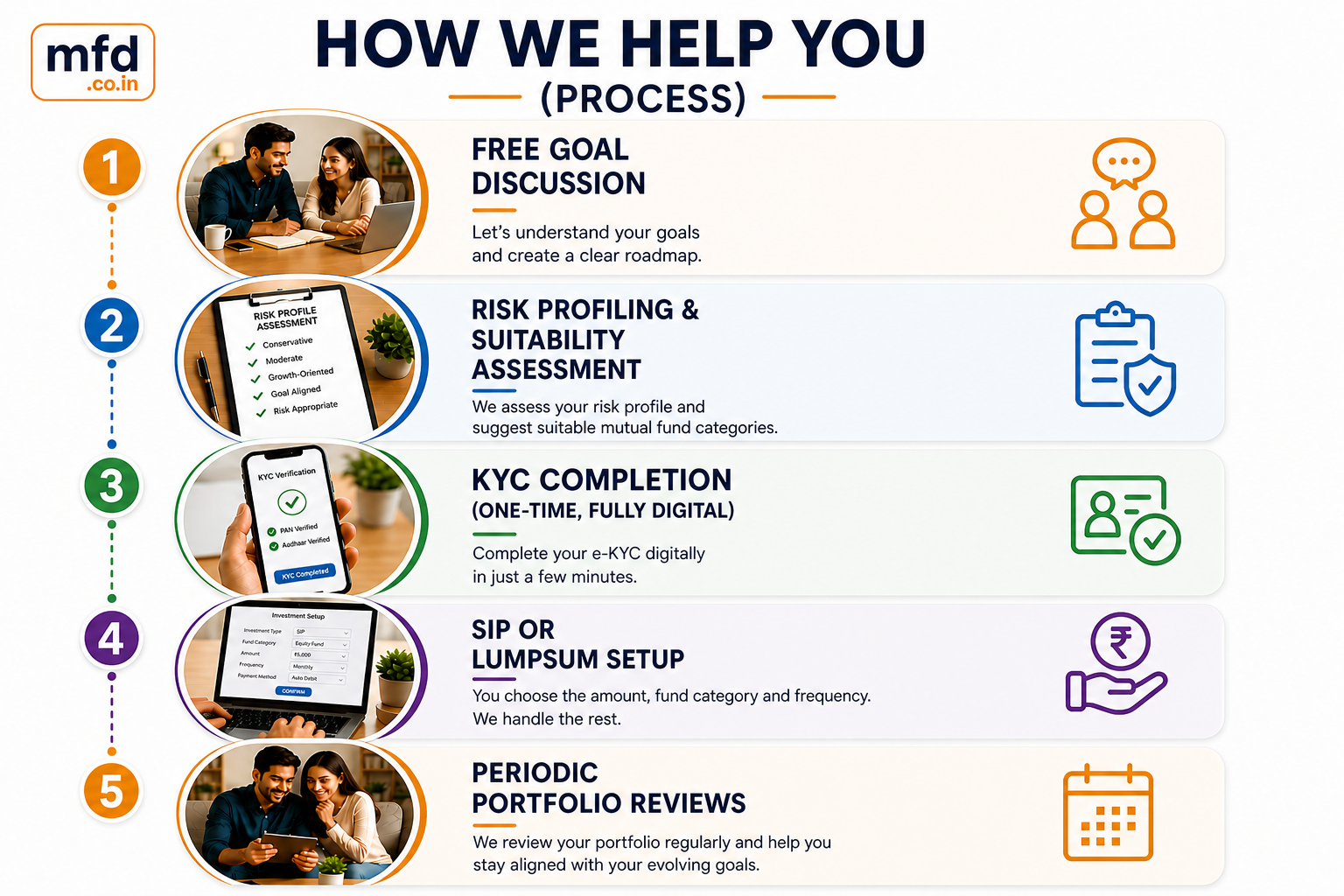
Here’s Exactly What Happens When You Reach Out
No jargon. No pressure. No hidden steps.
Step 1: Free Goal Discussion (15–20 Minutes)
We talk about your financial goals, income, family situation, existing investments, and time horizons. Nothing is sold in this conversation. You just get clarity on where to start.
Step 2: Risk Profiling & Suitability Assessment
As required under SEBI and AMFI guidelines, we assess your investor profile – conservative, moderate, or growth-oriented, and identify suitable mutual fund categories aligned to your goals and risk comfort.
Step 3: KYC Completion (One-Time, Fully Digital)
PAN + Aadhaar-based e-KYC. Completed digitally in minutes. Mandatory for all mutual fund investors in India, we guide you through every step.
Step 4: SIP or Lumpsum Setup
You decide the amount, fund category, and frequency, with full guidance at every stage. Your investment goes directly to the AMC (Asset Management Company). It never passes through us.
Step 5: Periodic Portfolio Reviews
We review your portfolio at regular intervals to check whether your investments remain aligned to your goals, and help you adjust when life circumstances change.
Who This Is For?
This Guidance Is Right for You If…
- You are starting your first mutual fund SIP in India and want structured, clear guidance from a registered distributor
- You are a salaried professional or business owner planning to build long-term wealth through disciplined monthly investing
- You are a parent planning ahead for your child’s higher education – 10 to 15 years from now
- You want to save tax under Section 80C through ELSS and still participate in equity market growth (old tax regime investors)
- You have a lumpsum amount – a bonus, an inheritance, or a maturity payout, and want to deploy it wisely and systematically
- You value complete transparency about fund costs, distributor commissions, and the rationale behind every category suggestion
- You prefer working with a registered, accountable human distributor over a faceless app or algorithm
| This Is Not the Right Fit If… You are looking for stock tips, intraday trading guidance, F&O strategies, guaranteed returns, or speculative investment advice. We do not offer any of those, and under SEBI and AMFI guidelines, we are not permitted to. |


Not Sure Where to Start? That’s Completely Normal.
You don’t need to have it all figured out today. You don’t need a large corpus. You don’t need to know which fund to pick.
You just need one conversation – about where you are, where you want to go, and how a structured SIP or lumpsum plan can help you get there.
Mutual fund investments can begin with SIPs as low as ₹500/month. But there is no minimum amount required to start a conversation.
| Transparency Disclosure As an AMFI Registered Mutual Fund Distributor (ARN-349400), Amit Verma earns trail commission from fund houses on Regular Plan investments, disclosed transparently per AMFI guidelines and the SEBI (Mutual Funds) Regulations 2026. You remain in complete control of your investments at every stage. All investments are processed only after completion of mandatory KYC and investor consent. |